
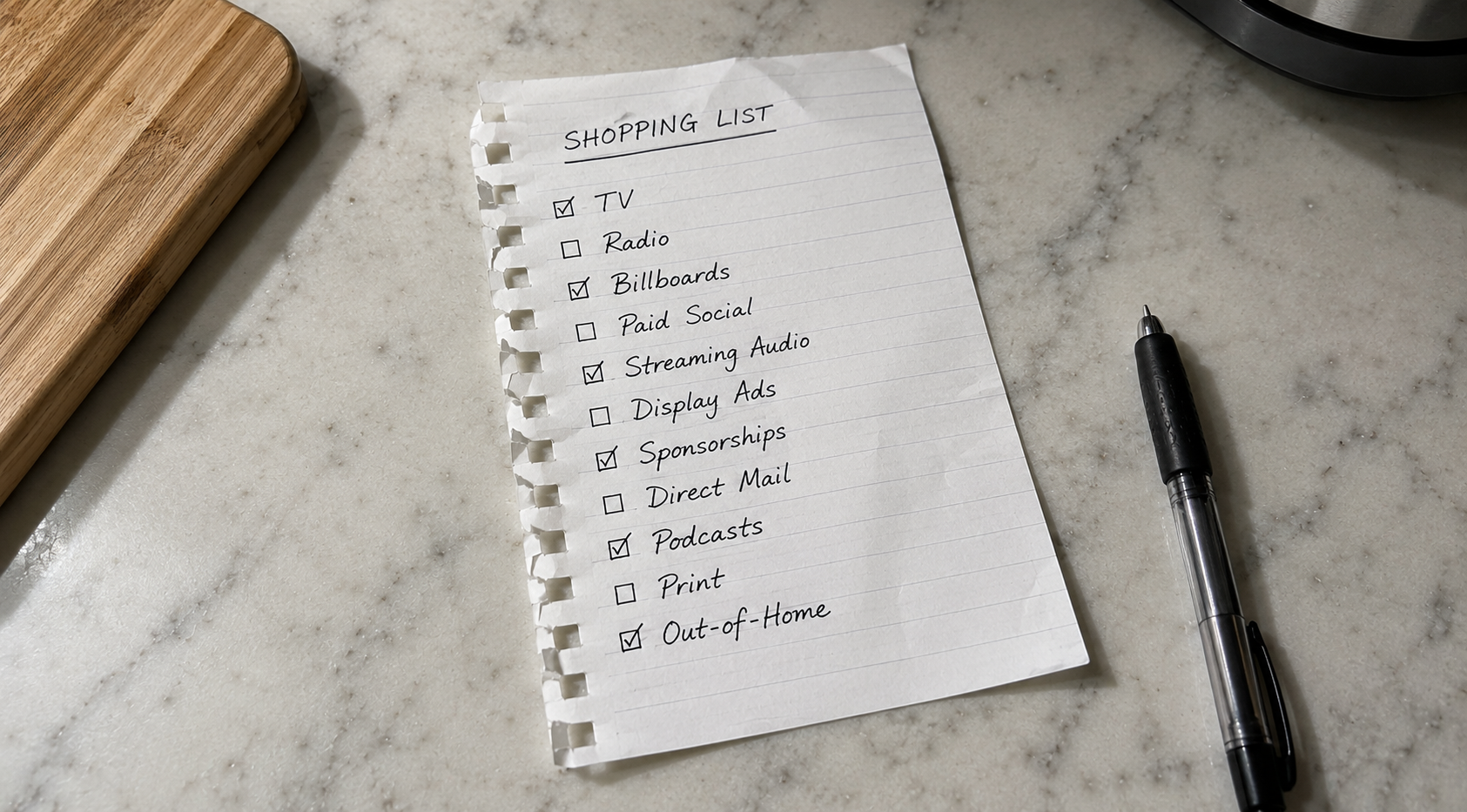
Too many media plans read like a shopping list. “Let’s run billboards.” “Let’s add TV.” “Let’s throw in some Facebook ads.” Maybe a little radio, a sponsorship, some display. But a list of channels isn’t a strategy. It’s just a list.
We hear it all the time. A brand calls Roux and says, “I want to run more Facebook ads, can you help me with that?” No context, no objective, no sense of what those ads are supposed to do. Facebook isn’t the goal. It’s a tool. And you don’t reach for a tool until you know what you’re building.
Think about how a marketing director at a hotel actually thinks. She isn’t sitting there deciding between TV, search, and social. She’s thinking, “I need to book rooms, and my cost per acquisition must stay under fifteen dollars.” From there the real questions follow. What makes someone choose this property over the one down the street? What’s the moment they decide to book? How does media show up in that moment and hijack the decision? The channel is the last thing she picks, not the first.
A shopping list works backward from a destination you’ve already chosen. You’re making lasagna Friday, so you buy the pasta, the sauce, the cheese. Every item has a job because the outcome is already clear. Media should work the same way, but the outcome has to come first. You don’t buy a billboard because billboards are “good.” You don’t buy TV because it feels important. You choose a channel because it solves a specific business problem. Unfortunately, too often that is not the case.
Strategy comes before channels
A strong media plan doesn’t start with “What should we buy?” It starts with “What needs to happen for the business to win?” Sometimes that’s awareness. Sometimes it’s credibility, demand capture, frequency, or defending share before a competitor takes it.
Picture a director of marketing for a restaurant group. Three of his locations are full every weekend. A fourth, brand new, is sitting half empty on Tuesdays. Those are two completely different problems. One needs trial and awareness in a new trade area. The other needs frequency and a reason to visit midweek. If the plan answers both with “let’s boost some posts,” it isn’t a plan. The strongest media plans don’t impress because they include everything. They impress because they include the right things, in the right order, for the right reason.
Why it breaks down as you scale
This matters more as a business grows. Scaling isn’t just spending more. It’s adding complexity, more markets, more products, more audiences, without losing efficiency.
That’s where a lot of marketing organizations start to slip. Budgets grow but performance doesn’t keep pace. Channels get added because a competitor is using them. Old tactics stay in the plan because they’ve always been there. Teams get busier while leadership gets less clarity on what’s actually driving growth.
When you can’t say which investments are working and which aren’t, marketing stops looking like a growth engine and starts looking like a cost center. Coverage gets mistaken for strategy. But coverage without logic is just noise, and noise is expensive. The cost isn’t only wasted impressions. It’s slower growth, weaker returns, and reactive decisions, shifting budgets and chasing results instead of scaling what works. Oh, and the cost is missed opportunities.
The Roux point of view
We believe media should work like a business system, not a channel checklist. The goal isn’t to buy attention for its own sake. It’s to create the conditions for growth, whether that means building awareness, earning credibility, capturing demand, or defending share before a competitor moves in.
So we keep it simple. Every dollar has a job. Every tactic connects to a measurable outcome. And every plan reflects how people actually buy, not how media looks in a deck, not how it was done last year, and not where competitors happen to be spending.
Real strategy starts with the business challenge, the moment customers decide, the competitive landscape, and the market opportunity. The channels come last, because by then they’ve earned their place.
About Roux Advertising
Roux Advertising builds media strategies that connect investment to revenue. We work with ambitious brands that demand proof, want to win decision moments, and are driven to lead their category. If your media is bought like items off a shopping list, we should talk.
To talk through your media strategy, contact Eric Morgan, President of Roux Advertising, at 504-561-5055 or eric@rouxadvertising.com.